Dispelling myths: media professionals learn PwDs want equal rights, not pity
September 5th, 2025
Sherab Lhamo, Kuensel, 8 August 2025
Yonten Jamtsho, who has low vision, shared his personal journey of learning Braille at Muenselling Institute, Khaling, as preparation for the possibility of future blindness. He explained that national policies on people with disabilities (PwDs) have been converted into Braille and that work is ongoing to translate important documents including three acts for the Election Commission of Bhutan, so that persons with disabilities can remain informed and actively participate in the country’s democratic processes.
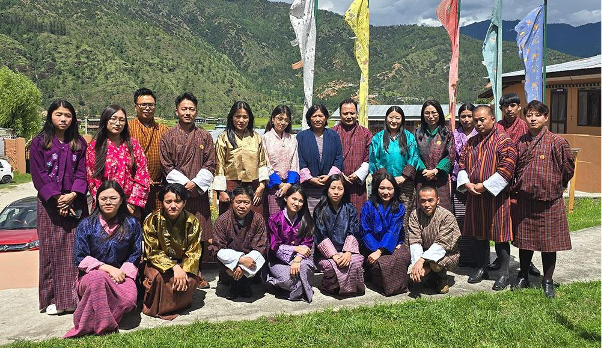
He was speaking at a two-day training organised by the Bhutan Media Foundation on sensitive reporting on women, children, PwDs, and LGBTQI+ communities. The workshop which ends today sought to equip media professionals with the knowledge and skills to ensure ethical and inclusive reporting on marginalised groups, with emphasis on applying relevant media guidelines and improving accuracy, dignity, and fairness in coverage.
The Programme Officer of the Disabled People’s Organisation, Younten, also presented several initiatives aimed at building a more inclusive society. These include the establishment of sign language interpreter courses, the development of Braille business cards for professional networking, and the production of Braille calendars for the coming year.
Addressing the broader realities of disability in Bhutan, he highlighted common myths, persistent challenges, and the lived experiences of PwDs. Despite growing awareness, he said, inaccessible infrastructure and transportation systems remain significant barriers, alongside limited opportunities for participation in social events.
He said that people with visual, hearing, and cognitive disabilities often lack access to information in suitable formats, such as recorded books, Braille materials, and Bhutan Sign Language applications. Stigma and discrimination continue to persist, with women with disabilities especially vulnerable to sexual abuse. Economic challenges further compound the situation, with the high costs of education and limited employment opportunities placing heavy financial burdens on families.
“These challenges partly stem from unconscious categorisation and assumptions,” Younten said, explaining how stereotypes and biases influence the way society treats people with disabilities.
He addressed several myths that reinforce misunderstanding. Contrary to the belief that disability is rare, he pointed out that one in six people globally live with a disability. He stressed that disability is a universal experience, noting that anyone may face it temporarily or permanently at some point in life, whether through a broken bone or age-related hearing loss.
Challenging the perception that PwDs cannot be independent or require sympathy, he explained that they seek equal rights and opportunities. Many live independently, support families, sustain careers, and lead organisations. He also countered the assumption that all disabilities are visible, pointing to conditions such as mental illness, epilepsy, and chronic pain. Likewise, he argued against the misconception that inclusion is too costly, citing evidence that exclusion and inaccessibility result in greater economic loss through reduced productivity and increased dependency.
Statistical data reflect a marked rise in reported disability rates. While the Population and Housing Census of Bhutan 2017 recorded 2.1 percent of the population as living with disability, the National Health Survey 2023 found the figure had risen to 6.8 percent or approximately 48,000 people. The 2023 survey showed the highest prevalence in self-care difficulties (2.4 percent), followed by hearing and mobility (both at 2 percent) and vision (1.8 percent).
Younten also outlined four models of understanding disability. The charity model views PwDs as objects of pity, while the medical model sees disability as a defect requiring cure or rehabilitation. In contrast, the social model and the rights-based model frame disability as the product of societal barriers and affirm PwDs’ fundamental rights to dignity, justice, and full participation in society.
He stressed the importance of language in shaping perceptions. He urged avoiding labels such as survivors, superhuman, brave, or courageous, sharing that disability is not an illness and that phrases like “suffers from” are inappropriate. Instead, he encouraged the use of person-first language that emphasises the individual, such as “a person with blindness.” Even small adjustments, he added, matters such as referring to “accessible toilets” rather than “disabled toilets.”
The workshop was supported by Helvetas with funding from the European Union.